Blog
Why Cheap Boat Stickers Fail in Australian Sun and Salt
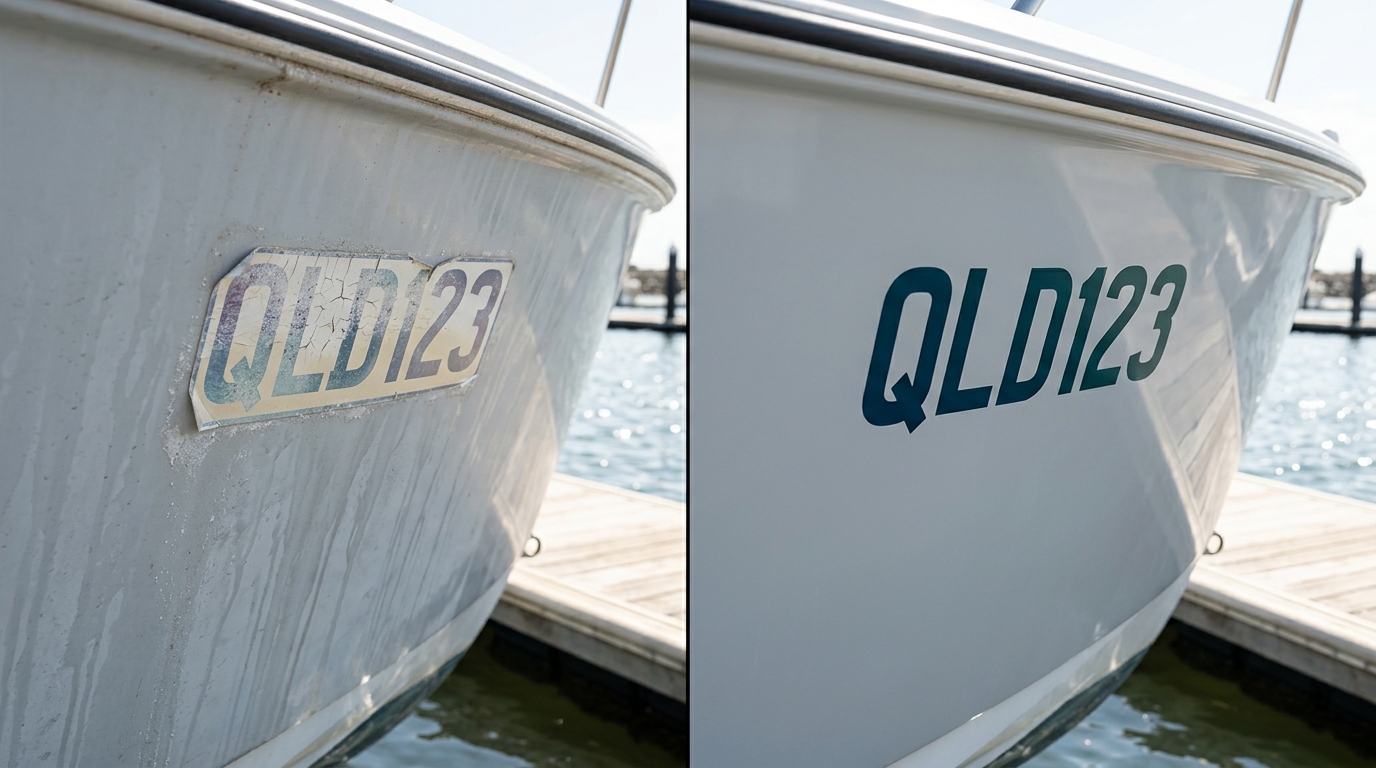
If you've ever peeled a curling, chalky rego number off a hull with a thumbnail and a swear word, you already know the problem. Cheap boat stickers don't fail because you did something wrong — they fail because the film was never built for an Australian summer. Between our UV index, saltwater immersion, trailer travel and the weekly high-pressure washdown, a hull is one of the harshest places you can stick vinyl. Get the film wrong and you're re-doing the job in eight months.
Here's what actually goes wrong, and what proper marine vinyl stickers need to survive years on the water rather than a single season.
What Australian conditions do to a decal
Three forces attack a hull decal, usually at the same time.
UV. Australia sits under some of the highest UV levels in the populated world, and a boat parked on a driveway or hardstand gets it all day, plus the reflected dose bouncing off water and white gelcoat. Cheap PVC films use low-grade pigments and minimal UV stabilisers. The result is fading (reds go pink, blues go grey), then chalking, then the film going brittle and cracking like old paint.
Salt. Saltwater doesn't just sit on the surface — it works into the edges of a decal and under any lifted corner. Once salt crystallises under the film it acts like a wedge, breaking the adhesive bond from the outside in. That's why cheap decals almost always fail at the edges and corners first, not in the middle.
Mechanical abuse. Then there's the physical side: pressure washing after every trip, deckies dragging fenders down the side, trailer road grime, bilge cleaners, and repeated wet-dry cycles at the waterline. A film without decent thickness and dimensional stability shrinks, tears at the corners or lifts under the lance.
The five reasons cheap stickers fail
1. Monomeric vinyl instead of cast or premium calendered film
This is the big one. The cheapest sign vinyls are monomeric — the plasticiser that keeps them flexible is a small, mobile molecule that migrates out over time. As it leaves, the film shrinks and hardens. On a flat sign under an awning that might take years. In marine sun it can happen inside a season, which is why you see rego numbers that have shrunk back from their own outline and cracked across the middle of each character.
Premium cast and polymeric films use larger, stable plasticisers and heavier UV packages. They stay flexible, keep their dimensions and hold colour. We use German-engineered ORAFOL marine vinyl for exactly this reason — it's the same class of film used on commercial fleet and marine work, not the throwaway stuff on a discount roll.
2. The wrong adhesive
Adhesive is not just "sticky". Marine work needs a permanent acrylic adhesive that continues curing and building bond strength after application, and that tolerates constant wet-dry cycling. Cheap rubber-based adhesives soften with heat, go gummy, and release when salt water tracks under the edge. That's the decal that looks fine in the shed and starts lifting three trips later.
3. Not enough film thickness or conformability
Hulls aren't flat. You've got chines, rivet lines on a tinny, gelcoat texture, curved bow flare and hypalon or PVC tubes on an inflatable. Thin, stiff film bridges over these features instead of conforming, and every bridged spot is a future failure point where water gets in. That's also why inflatables and RIBs need a different approach entirely — worth reading our notes on registration decals for inflatable boats and RIBs before you order.
4. Poor colour and contrast choices
Some colours simply hold up better than others. Dark colours run hotter in the sun, and certain bright pigments are inherently less UV-stable. Just as importantly, the wrong colour against your hull becomes unreadable long before it physically fails — a compliance problem as well as a cosmetic one. Our guide on choosing boat sticker colours for contrast and longevity walks through what works on white gelcoat, bare alloy and dark hulls.
5. Rushed application
Even good film fails if it goes on badly. Wax, silicone polish, mould release, salt residue and moisture in the surface all kill adhesion. So does applying below about 10°C, or applying in blazing midday sun onto a hull hot enough to cook the adhesive before you can squeegee it down. Half the "bad sticker" complaints out there are actually contamination and temperature issues.
What good marine vinyl decals actually need
If you're comparing options, here's the practical checklist. Proper boat decals for Australian conditions should have:
- A named premium film — cast or high-grade polymeric marine vinyl, not an unspecified "vinyl sticker"
- Permanent acrylic adhesive rated for outdoor marine exposure and wet-dry cycling
- Genuine multi-year outdoor durability, not a vague "long lasting" claim
- UV-stable pigments so colour and contrast hold, not just the film
- Pre-spaced characters on application tape so spacing stays even and legal-looking — our rego numbers ship as a pre-spaced pair with a squeegee and instructions, so you're not aligning loose letters by eye
- Correct character height for your state — generally 150mm minimum for boats and 100mm for PWC, though this varies
You can see the full range of marine-grade marine vinyl boat decals we make, or go straight to custom boat registration stickers if it's hull numbers you're chasing. Compliant sets start from $49.99 per pair across 24 colours including reflective and metallic finishes.
How to make good decals last even longer
Film grade gets you most of the way. Habits get you the rest.
- Prep properly. Wash with detergent, then wipe the exact application area with isopropyl alcohol. Never wax the panel before applying — and mask around decals when you polish later.
- Apply in the shade at moderate temperature, on a completely dry surface. Let the adhesive cure a few days before the boat gets wet if you can.
- Keep the pressure washer off the edges. Don't blast a lance at close range straight into a decal edge. Wide fan, sensible distance, angle away from the film.
- Rinse salt off after every saltwater trip. This matters more than anything else you'll do.
- Avoid aggressive solvents and abrasive polishes over the decal — cutting compound will haze and thin the film fast.
- Cover or garage the boat where practical. Shade is the cheapest UV protection there is.
There's more detail in our boat rego sticker maintenance guide, and if you want realistic expectations rather than marketing numbers, see how long boat rego stickers actually last.
When to stop patching and just replace
A decal that's faded to the point where the characters no longer clearly contrast with the hull is a legibility problem, and legibility is what marine officers actually look at. Same goes for cracked characters, lifted corners, or a number where one digit has partially peeled away. At that point you're not maintaining a decal, you're delaying a job.
Removing old film properly matters too — heat, patience and the right adhesive remover, not a scraper on gelcoat. Our walkthrough on removing old boat stickers without damaging the hull covers the safe method, and replacement boat rego stickers are made to the same marine spec as a new set.
FAQ
Are cheap boat stickers ever fine?
For a boat that lives in a shed and gets used twice a year in freshwater, a budget decal might survive a while. For a saltwater boat on a trailer in the sun, no — you'll pay twice.
Does reflective vinyl last as long as standard colours?
Quality reflective marine film holds up well, but reflective and metallic finishes are more sensitive to abrasive polishing and harsh solvents. Wash gently and keep cutting compounds away from them.
Can I apply new decals over old ones?
Don't. The new film will telegraph the old edges, and you inherit whatever adhesive failure was already happening underneath. Remove, clean, then apply.
What kills decals fastest — sun or salt?
UV does the visible damage (fading, chalking, cracking). Salt does the invisible damage (edge lift and adhesive failure). Australian boats get both, which is why film grade matters so much here.
Getting it right the first time
The difference between a decal that lasts one summer and one that lasts years isn't luck or clever application tricks — it's the film, the adhesive and ten minutes of proper prep. Spend the extra on marine-grade vinyl once and you stop thinking about it.
When you're ready, you can lay out your numbers, pick your height and colour, and see exactly how it'll look before you buy using our online boat rego sticker designer. Orders dispatch within 24–48 hours Australia-wide.
Rules vary by state and territory. Always confirm current character height, placement and contrast requirements with your state maritime authority. We manufacture compliant-style decals; final compliance depends on correct size, placement, contrast and display on the vessel.