Blog
Are Round or Two-Line Boat Rego Stickers Legal in Australia?
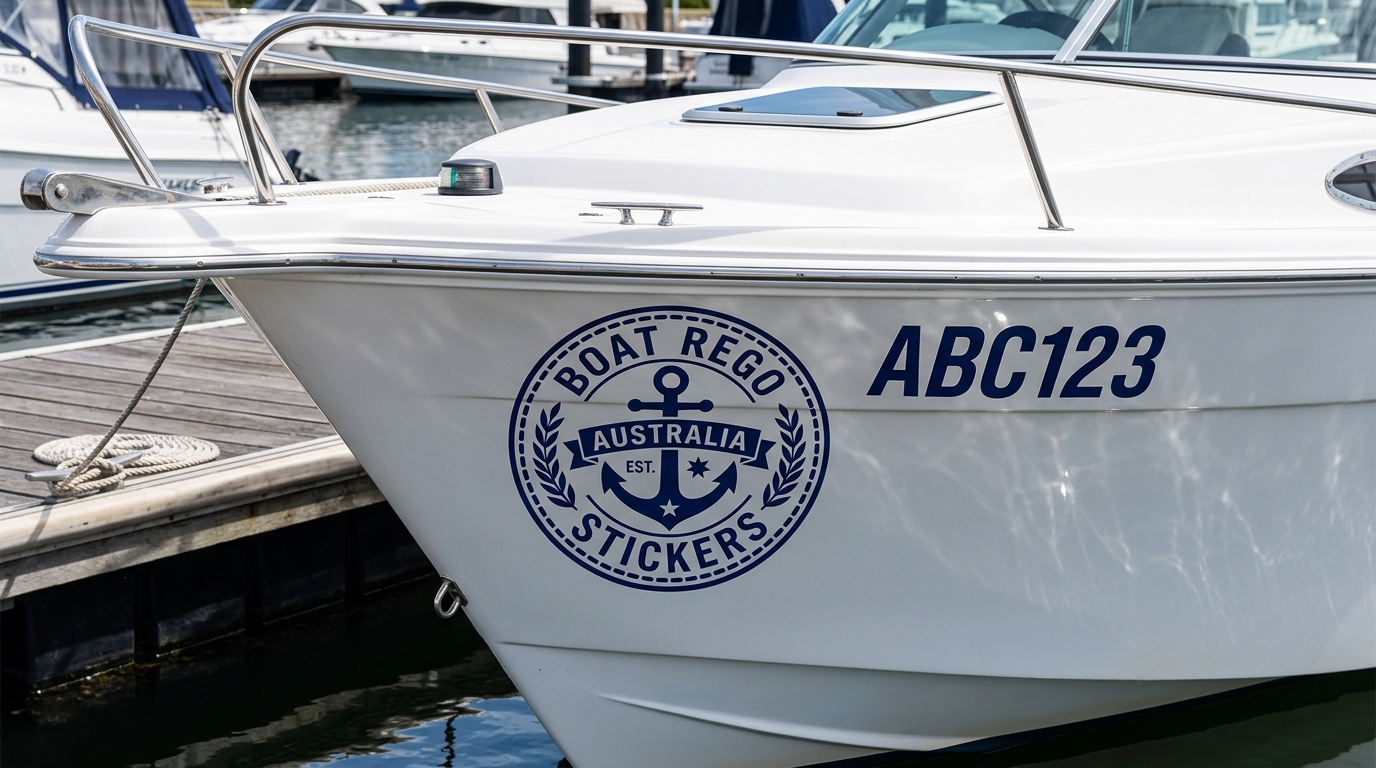
Round boat rego stickers and two-line boat registration numbers are one of the most common questions we get, and the honest answer is: it depends on your state, your hull shape, and how well the finished decal actually reads from a distance. There is no single national rule that says a stacked or curved layout is banned, and there is no rule that guarantees it is accepted either. What most maritime authorities care about is that your numbers are the right height, clearly legible, in strong contrast to the hull, and displayed on both sides of the bow.
This guide walks through where the style genuinely works, where a straight single line is the lower-risk choice, and how to verify your own requirements before you spend money on decals.
What the rules actually care about
Across Australia, state and territory display requirements tend to focus on the same handful of things rather than on decorative style:
- Character height: generally a minimum of 150mm for boats and 100mm for personal watercraft, though you must confirm your own state's figure.
- Legibility: numbers must be readable, usually described as legible from a reasonable distance on the water.
- Contrast: the characters must stand out clearly against the hull colour behind them.
- Placement: both sides of the bow, above the waterline, unobstructed.
- Spacing and order: characters shown in the correct sequence, with clear separation so they cannot be misread.
Notice what is missing from that list: nothing about whether the characters sit in one line, two lines, or follow a curve. That silence is exactly why the question keeps coming up. Some readers take silence as permission, others take it as risk. Our position is simple and unromantic: style choices are fine as long as they never compromise height, legibility or contrast. The moment they do, you have a compliance problem regardless of how good the decal looks in the driveway.
You can compare the display requirements that apply to you on our Australian boat registration requirements guide, then confirm the detail with your own state maritime authority.
When a round or two-line layout genuinely works
There are real situations where a stacked or arched layout is the practical answer, not just a styling preference.
Short, high bow flats
Some hulls simply do not have a long enough flat panel forward to fit a full registration in one straight line at the required character height. Runabouts with a short bow section, deep-vee hulls with heavy flare, and some centre consoles fall into this group. On those boats, dropping to a smaller character height to make a single line fit is the worse compromise, because height is usually a hard minimum. A two-line layout that keeps every character at the correct height is generally safer than a single line that shrinks below the minimum.
Round and circular hull decals
Our round boat rego stickers suit boats where the registration reads better inside a defined badge shape, particularly darker hulls where a contrasting disc gives the characters a clean background. The characters themselves still need to meet your state's height rule. The surrounding circle is decoration; it does not count towards character height, and it should never crowd the numbers.
Tenders, dinghies and inflatables
Small craft with tubes, rubbing strakes and narrow bow panels are the classic case for a stacked layout. If you are marking a dinghy against a parent vessel, look at tender-to stickers instead, which usually run as a stacked two-line format by design. Inflatables and RIBs have their own surface challenges, covered in our inflatable boat rego sticker guide.
When a straight single line is the safer choice
If your hull has room for it, a single straight line at full character height is the lowest-risk option in the country. That is not a design opinion, it is a risk assessment. A single line is unambiguous. Nobody inspecting your boat has to decide whether the second row reads as a continuation or as separate information.
Go straight and single-line if any of the following apply:
- You have a flat bow panel with enough length for the full number at the minimum height.
- Your registration contains characters that could be misread when stacked, such as combinations where the break point creates a confusing grouping.
- You use the boat commercially, in surveyed operations, or somewhere it will be inspected regularly.
- Your state's wording specifically describes numbers as being displayed in a line or in sequence, which some readers interpret as a single horizontal row.
- You want zero conversation with a marine officer about layout.
Standard pre-spaced custom boat registration stickers are supplied as a full number on application tape, so a straight line is also the easiest thing to apply cleanly. There is no character-by-character alignment guesswork.
The mistakes that actually cause problems
In our experience, style is rarely the thing that lands boat owners in trouble. These are the real culprits.
Shrinking characters to make a design fit
This is the big one. Owners commit to a curved or stacked look, run out of room, and quietly drop from 150mm to 120mm characters. Height is usually the measurable, black-and-white part of the rule. Never trade it for aesthetics.
Poor contrast
Dark grey characters on a dark blue hull will read poorly on the water no matter how neat the layout. Outline and shadow effects can help, but the core character colour still has to do the work. Our guide to choosing boat sticker colours covers contrast pairings that hold up in glare.
Too little gap between the two lines
If a stacked layout is tight, the two rows can visually merge and the number becomes hard to read quickly. Leave generous separation and check it from ten or fifteen metres away before you commit.
Placement drift
Stacked layouts are taller overall, so they are more likely to creep towards the waterline, over a rubbing strake, or behind a bow rail fitting. Measure first using our boat registration number placement guide.
How to check your state before you order
Do not rely on what someone at the ramp told you, and do not rely on what the boat had on it when you bought it. Previous owners get this wrong constantly.
- Read your state or territory's display rules. Start with our summaries for NSW, Queensland, Western Australia or Victoria, then confirm against the current official source.
- Write down the minimum character height that applies to your vessel type. Boat and PWC minimums differ.
- Measure your available bow panel in both directions. Length available for a single line, and height available if you stack. Our measuring guide walks through it.
- Ask your state authority directly if you still cannot fit a compliant single line. A short email asking whether a two-line display at the minimum height is acceptable on your hull is the only way to get a definitive answer.
- Keep the reply. If you get written confirmation, save it with your registration papers.
If you need to confirm your registration details or expiry before ordering, our boat registration check guide points to the official state checkers. We do not run a lookup service ourselves.
Designing a stacked or round layout properly
If you have confirmed the style is acceptable for your vessel, build it carefully. Choose a sensible break point in the registration rather than splitting mid-way through a character group that then reads oddly. Keep both rows at the same height, the same colour, and the same font weight. Avoid heavy decorative effects that reduce apparent contrast at distance.
You can preview layouts and heights in our online boat rego designer, or build a bordered version through the round rego builder. If you like a defined edge for contrast on a coloured hull, the outline boat rego option often gives you the visual pop of a styled decal while keeping the characters in a straightforward line.
Everything is cut from ORAFOL marine vinyl, supplied pre-spaced on application tape with a squeegee and instructions, so alignment is handled for you once you have decided on the layout.
Frequently asked questions
Are two-line boat registration numbers illegal in Australia?
There is no blanket national ban that we are aware of, but there is also no blanket approval. Most state rules focus on height, contrast, legibility and placement rather than layout. Because interpretations differ, confirm with your state maritime authority before ordering if you plan to stack your number.
Do the characters in a round decal need to be full height?
Yes. The circle, border or background shape is decoration and does not count towards character height. Your characters still need to meet the minimum that applies in your state, generally 150mm for boats and 100mm for PWC.
What if my bow is too small for a single line?
Do not shrink the characters. Either move to a stacked layout at full height after confirming acceptance with your state, or look for an alternative compliant placement position on the hull as permitted by your state's rules.
My boat came with two-line numbers. Are they fine?
Not necessarily. Previous owners frequently get display rules wrong, and older decals also fade below acceptable contrast. If yours are faded, cracked or peeling, replacement boat rego stickers are a cheap fix compared to the hassle of an inspection issue.
Does the same thinking apply to jet skis?
Broadly yes, though PWC have even less flat panel area to work with and a lower minimum height. See jet ski registration stickers for sizing options built around typical PWC hull shapes.
The honest bottom line
Round and two-line registration numbers can look sharp, and on some hulls they are genuinely the more practical way to display a compliant number at full character height. But we will not tell you they are guaranteed legal everywhere, because that depends on your state's wording and how the layout is executed. If your bow can carry a straight single line at the minimum height, that is the safest choice every time. If it cannot, stack it properly, keep the height, keep the contrast, and get confirmation in writing.
Rules vary by state and territory. Always confirm current requirements with your state maritime authority. We manufacture compliant-style decals, and final compliance depends on correct size, placement, contrast and display on the vessel.
When you are ready, measure your bow, check your state rule, then build your layout in the boat rego sticker designer and see exactly how it will sit before you order.