Blog
Boat Lettering vs Boat Name Stickers vs Name Decals: Same Job, Different Words
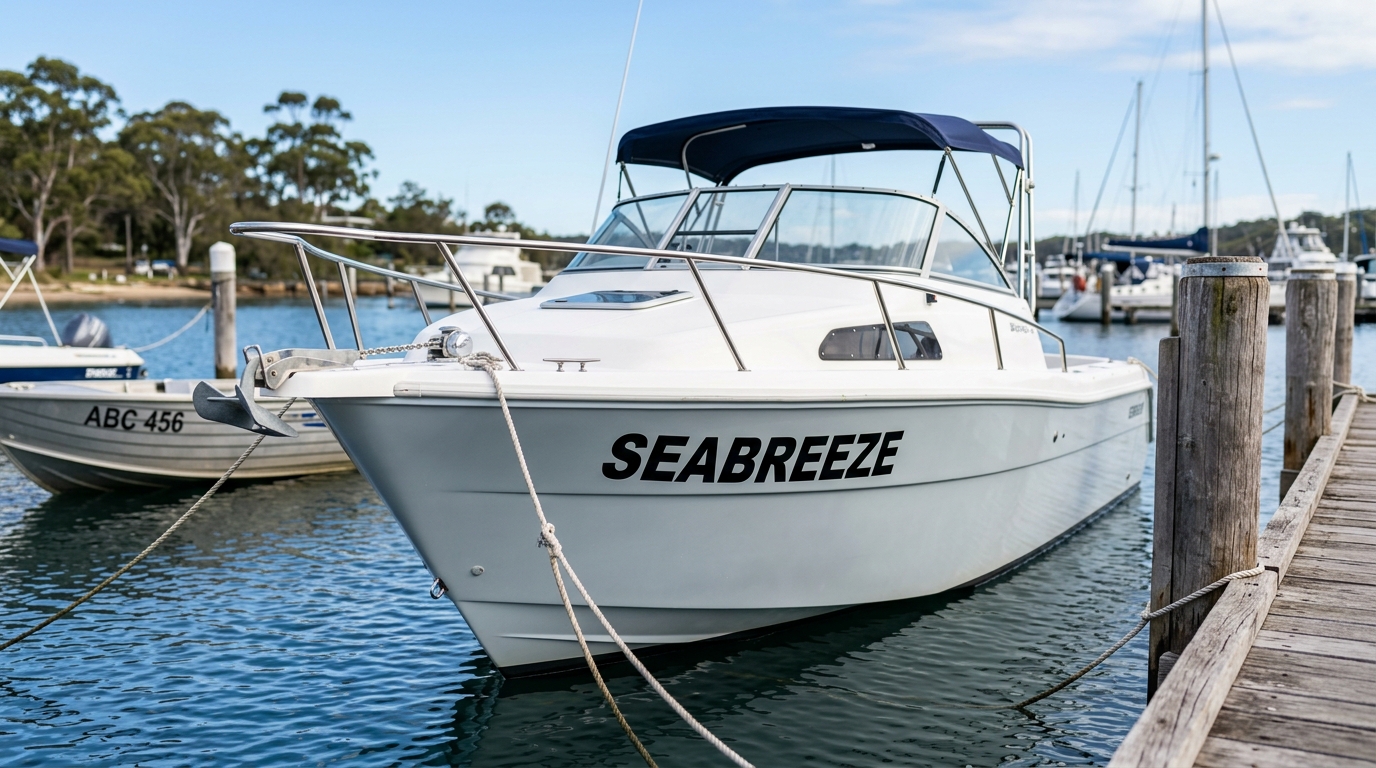
Search for boat lettering and you'll get one set of results. Search for boat name stickers and you'll get another. Search vinyl boat lettering or boat name decals and you'll land somewhere else again — even though, in almost every case, all four terms describe exactly the same thing: cut marine vinyl letters applied to your hull or transom to spell out your boat's name.
The confusion is understandable. Different states, different marinas, different signwriters and different generations of boaties all picked up a different word for it. This guide sorts out the terminology in about two minutes, then spends the rest of the time on the decisions that genuinely affect how your name looks and how long it lasts on an Australian hull.
The terminology, sorted
Here's the plain-English breakdown of the four terms people use most:
- Boat lettering — the trade term. Signwriters have used it for decades. It emphasises the letters themselves rather than the finished graphic. If you ask a boat yard for "lettering", this is what you'll get.
- Vinyl boat lettering — the same thing, with the material named. It distinguishes cut vinyl from painted or hand-lettered names, which is what most older vessels originally had.
- Boat name stickers — the everyday term most Australian recreational owners use when they go looking online. Functionally identical.
- Boat name decals — slightly more American in flavour but widely used here too. "Decal" usually implies a pre-spaced graphic on application tape, which is how quality name lettering is actually supplied.
The only genuine difference worth knowing is individual letters versus pre-spaced lettering. Individual loose letters mean you're doing the spacing, levelling and alignment yourself on a curved hull, in the wind, usually with someone unhelpfully offering advice from the ramp. Pre-spaced lettering arrives as one piece on application tape with the kerning already set, so you position once and squeegee down. Our vinyl boat lettering is always supplied pre-spaced for exactly that reason.
Getting the size right
Unlike registration numbers, boat names generally aren't governed by a minimum character height. That's freeing and it's also where most people get it wrong — they either go too small and lose the name from 20 metres away, or go too large and crowd the transom.
A few practical rules of thumb from hulls we've supplied:
- Tinnies and small runabouts (3–4.5m): 50–75mm character height suits most transoms.
- Mid-size trailer boats (4.5–6m): 75–100mm works well, and 100mm reads cleanly across a car park.
- Larger trailer boats and cabin boats (6–8m): 100–150mm.
- Long names: drop a size. A 14-character name at 150mm needs well over a metre of clean, flat-ish surface.
Before you commit, measure the actual usable panel — not the whole transom. Rub rails, hinges, bungs, transducer brackets, boarding ladders and self-draining scuppers all eat into the space. Mask out the area with painter's tape and step back 10 metres. If the tape block looks right, the lettering will too. Our guide to measuring for boat stickers walks through the same process used for rego numbers, and the method carries over exactly.
Where the name usually goes
Transom is the traditional home for a boat name, often with the home port beneath it in a smaller size. Some owners also run the name along the upper hull sides forward of the rego numbers — just keep clear separation so nothing interferes with the visibility of your registration display.
Choosing a colour that survives an Australian hull
Colour choice is where good intentions meet Australian sun. Two things matter: contrast against your hull, and how the colour behaves under UV and salt.
Contrast first. A name is only worth having if it can be read. White hulls take almost anything dark — gloss black, navy, deep burgundy, charcoal. Dark blue and black hulls need white, silver, gold or a light metallic. Bare and painted aluminium is the tricky one, because raw alloy is mid-tone and reflective; strong blacks and whites both work, mid-greys rarely do.
Then finish. Gloss black is the default for a reason — it's crisp, it photographs well, and it reads at distance. Matte black has become popular on modern grey-hulled centre consoles and plate boats, and it hides surface imperfections better than gloss. Metallics and gold look excellent on darker gel coat but can wash out on white. Reflective vinyl is more of a rego and safety colour than a name colour, though some owners like it on the transom for low-light visibility at the ramp.
We stock 34 colours across gloss, matte, metallic and reflective, and if you're weighing options against your gel coat, the colour selection guide covers which combinations hold up best in strong sun.
Why the vinyl itself matters more than the design
This is the part that separates a name that still looks sharp in five seasons from one that's chalky and lifting by the second summer. Not all vinyl is marine vinyl.
General-purpose sign vinyl is engineered for shopfronts and vehicle doors — shaded, washed occasionally, rarely submerged. A boat hull is a completely different environment:
- Constant UV load, especially on trailer boats stored uncovered
- Salt exposure and repeated wet/dry cycles
- High-pressure washdowns after every trip
- Trailer flex, road grit and highway speeds
- Waterline immersion and, for some hulls, marine growth and antifoul contact
We use German-engineered ORAFOL marine vinyl for exactly those conditions. It holds colour under Australian UV, resists edge lift on curved gel coat, and tolerates pressure washing without the edges curling — which is where cheap vinyl always fails first. Every order includes a squeegee and instructions, and the same application technique used for rego numbers applies to names. If you haven't fitted vinyl before, the step-by-step application guide is worth five minutes before you peel anything.
Fonts, outlines and keeping it legible
Two mistakes come up again and again. The first is a font so decorative that nobody can read the name from the next berth. The second is a very thin script in a colour close to the hull, which disappears entirely in bright sun.
Bold sans-serif fonts read best at distance and suit fishing and plate boats. Script fonts look great on cruisers and classic hulls but need to go up a size to stay legible, because the stroke weight is thinner than the letter height suggests. Italics and forward slants suit sportsboats and tend to work well on hull sides.
If you're on a hull colour where a single-colour name struggles, an outline treatment fixes it, a contrasting keyline around each letter separates the lettering from the background. You can build that with our outline boat name lettering option, which is particularly useful on grey, silver and bare alloy hulls.
Still deciding on the name?
Plenty of owners have the boat before they have the name. If you're stuck between three shortlisted options, run them through the boat name ideas tool for inspiration, then type each one into the designer at your chosen size and colour. Seeing a name laid out at actual character height settles arguments faster than any amount of discussion at the ramp.
A practical tip: say the name out loud as if you were calling it over VHF. Names that are hard to pronounce, easily confused, or awkward to spell letter by letter get old quickly on the water.
Frequently asked questions
Are boat lettering and boat name stickers different products?
No. They're different search terms for the same marine vinyl lettering. "Lettering" is the trade word, "name stickers" and "name decals" are what most owners search for. What matters is that the vinyl is marine grade and supplied pre-spaced.
Do I need a minimum letter height for a boat name?
Boat names generally aren't size-regulated the way registration numbers are rego numbers have specified minimum heights (commonly 150mm for boats and 100mm for PWCs, with variations by state). Rules vary by state and territory, so confirm current requirements with your state maritime authority. We manufacture compliant-style decals; final compliance depends on correct size, placement, contrast and display on the vessel.
Can I put a name on an aluminium tinny?
Yes. Marine vinyl bonds well to clean, painted or bare aluminium provided the surface is degreased and completely dry. Avoid applying over heavy oxidation or fresh, uncured paint.
How long will vinyl boat lettering last?
Quality marine vinyl on a properly prepared hull typically lasts several seasons. Covered storage, rinsing after saltwater use and keeping high-pressure nozzles off the decal edges all extend its life considerably.
Can I match my name lettering to my rego numbers?
Absolutely, and it's the tidiest result. Choose the same colour and finish for both so the transom and hull sides read as one job rather than two.
Pick your words, then pick your vinyl
Whether you call it boat lettering, name stickers or name decals, the decisions that matter are the same: a character height that reads from the ramp, a colour with genuine contrast against your hull, and marine-grade vinyl that won't chalk out after one Australian summer.
When you're ready, lay it out and see it before you buy. Set your font, size and colour in the boat name designer, or browse the full range of boat name decals from $54.99 for a pair. Orders are dispatched within 24–48 hours, with 4–6 days to metro areas and 6–10 days regional.